
Overview
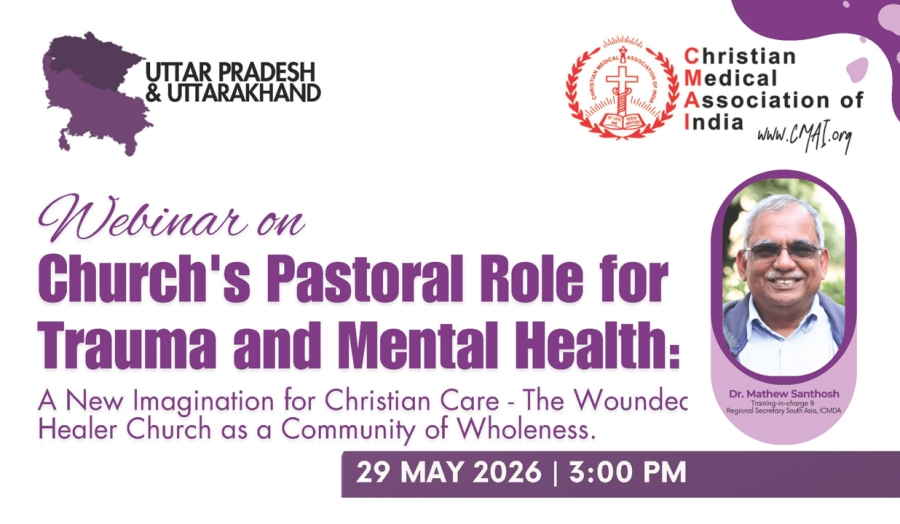
The Doctors Section and the UP-UK Region of the Christian Medical Association of India (CMAI) recently organized a vital webinar titled "The Church’s Pastoral Role for Trauma and Mental Health: A New Imagination for Christian Care." Led by Dr Santhosh Mathew, President of CMAI, the session challenged Church and healthcare leaders to move beyond traditional medical models toward a wholistic "Wounded Healer" approach.
Participation and Reach
The event saw overwhelming engagement from across the country, highlighting the urgency of mental health discourse within the faith community.
The webinar saw significant engagement with over 150 registrations and approximately 200 total attendees, more than 150 of whom remained active for over an hour. Registration data indicated that 43.8% of participants had prior knowledge of trauma and mental health, while 26.6% had no prior understanding and roughly 30% reported only limited familiarity with the subject.
Participation was geographically diverse, with the top five regions collectively accounting for 70% of the audience. The UP and UK region led with 24% of participants, followed by Tamil Nadu and Puducherry at 14%, Maharashtra and Goa at 11%, the North East at 11%, and Kerala at 9%.
Key Insights and Themes
1. A Legacy of Care
Dr Santhosh Mathew reminded participants that the Church has a historical mandate for healthcare. During the Plague of Cyprian (250–262 AD), when secular professionals fled, the Church stepped in to care for the sick. The webinar called for a return to this legacy, viewing healthcare not just as a professional service, but as a community of caring.
2. Shifting the Theological Paradigm
The session addressed the "disintegration" of the human person in modern theology:
Body vs. Soul: Moving away from the "Body as a Machine" view where healing is merely an entry point for evangelism.
Emotional Christianity: Challenging the stigma that mental health struggles (like depression) are purely "spiritual issues" or a "lack of faith."
Wholistic Integration: Emphasizing that humans are an integrated unity of body, mind, and spirit.
The "Wounded Healer"
Drawing on the work of Henri Nouwen, Dr Santhosh Mathew explored the concept of the Wounded Healer. He emphasized that leaders do not need to hide their wounds to be effective. Instead, by being vulnerable and sharing their own journeys—as Dr Ronald Lalthanmawia did by sharing his experience of isolation during COVID-19—leaders create a safe space for others to seek healing.
Modern Context: Loneliness and Gen Z
The webinar touched upon the "Loneliness Epidemic" (WHO 2025) and the sharp rise in depression among Gen Z since the social media boom of 2014. It was noted that while hospitals often focus on physical health, 60% of young people feel their mental health is neglected by the current healthcare system.
3. Moving Forward: The Church’s Response
The webinar concluded with actionable steps for Church and mission leadership:
- Mental Health Literacy: Leaders must develop a basic understanding of mental health "red flags."
- Culture of Vulnerability: Overturning the "macho" or "indispensable" leader image to allow for authentic sharing.
- Mental Health Audits: Implementing yearly audits to check the well-being of pastors and healthcare workers.
- Community Models: Exploring non-professional, community-based support systems like "Day Care for the Elderly" to combat loneliness.
As Dr Santhosh Mathew noted, "A church that ignores mental health is irrelevant to the health needs of its members and the mission field." CMAI remains committed to integrating mental health as a core pillar of its future strategy.