
Building Safer Operation Theatres: Key Insights from CMAI's Disaster Resilient Hospitals Webinar
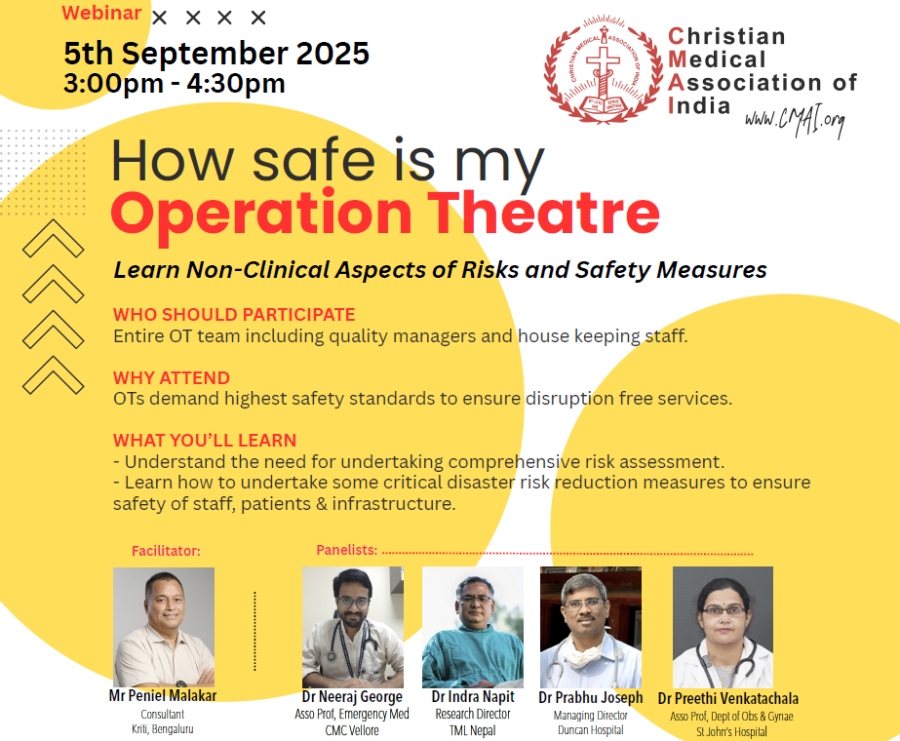
The Christian Medical Association of India (CMAI) successfully conducted the second webinar in their Disaster Resilient Hospitals Series on September 5, 2025, focusing on non-clinical safety risks in operation theatres. Moderated by Dr Abhijeet Sangma and facilitated by disaster management expert Mr Peniel Malakar, the session brought together healthcare professionals from India and Nepal to address critical safety gaps beyond traditional clinical protocols.
The distinguished panel shared powerful real-world experiences that highlighted both vulnerabilities and solutions.
- Dr Neeraj George (CMC Vellore) presented a comprehensive framework categorizing non-clinical hazards into four domains: infrastructure risks (fire hazards, electrical failures, HVAC problems), human factors (communication breakdowns, fatigue-related errors), environmental concerns (radiation exposure, chemical safety), and technology dependencies (equipment failures, cybersecurity vulnerabilities). He stressed that operation theatres require "cockpit-grade safety" with systematic planning similar to aviation standards.
- Dr Indra Napit (TLM Nepal) recounted two fire incidents at Nepal's 60-year-old Anandaban Hospital, where electrical sparks exposed dangerous safety gaps including improperly placed fire extinguishers, untrained staff, and absent alarm systems. Post-incident improvements included comprehensive staff training, proper alarm systems, and construction of a new operation theatre with modern safety features.
- Dr Preethi Venkatachala (St John's Hospital) described hospital's sophisticated emergency preparedness systems for their 2000-bed facility with 26+ operation theatres. Their multi-layered approach includes color-coded emergency protocols (Code Red for fire, Code Orange for mass casualties), WhatsApp groups for rapid mobilization, regular drills, and coordinated evacuation plans with backup operation theatre availability.
- Dr Prabhu Joseph (Duncan Hospital) shared about devastating flood experiences in 2007 and 2017, when 4-5 feet of water caused complete electrical failure, equipment contamination, and 2-3 week shutdowns resulting in significant economic losses. Their recovery strategy included disaster mitigation teams, elevating infrastructure above flood levels, alternative power systems, and regular mock drills.
The discussion addressed specific challenges facing mission hospitals with aging infrastructure and limited budgets. Experts identified the top three non-clinical risks as electrical system failures from overloaded circuits, inadequate backup power systems, and poor evacuation planning with insufficient staff training. For immediate low-cost improvements, they recommended regular equipment maintenance, staff training and drills, systematic risk assessment, and proper emergency supply placement.
For overwhelmed hospital administrators, the panel emphasized starting with comprehensive risk assessment, prioritizing operation theatre and backup systems, investing in training before expensive infrastructure, and focusing on one critical area at a time. All panellists stressed that training and regular drills represent the most cost-effective initial investments, creating a safety culture that prevents disasters more effectively than expensive equipment alone.
The webinar concluded with practical takeaways: immediate operation theatre safety walk-throughs to identify risks, verification of fire extinguisher and backup power functionality, establishment of incident reporting systems, completion of comprehensive risk assessments within three months, and commitment to ongoing monthly drills and quarterly equipment checks.
The session successfully demonstrated that operation theatre safety requires a holistic approach encompassing structural, electrical, environmental, and human factors. The shared experiences proved that while disasters can strike any facility, proper preparation significantly mitigates impact and ensures continued patient care during crises. As mission hospitals face increasing regulatory scrutiny, this webinar provided practical, resource-conscious approaches to building resilient operation theatres.
This successful instalment in CMAI's series will continue with future sessions on ICUs, pharmacies, and other critical hospital areas, maintaining CMAI's commitment to building comprehensive disaster resilience across Christian healthcare institutions. The key message resonated clearly: every life saved in operation theatres depends not just on surgical skill, but on the invisible safety net that keeps these facilities operational when disasters strike.